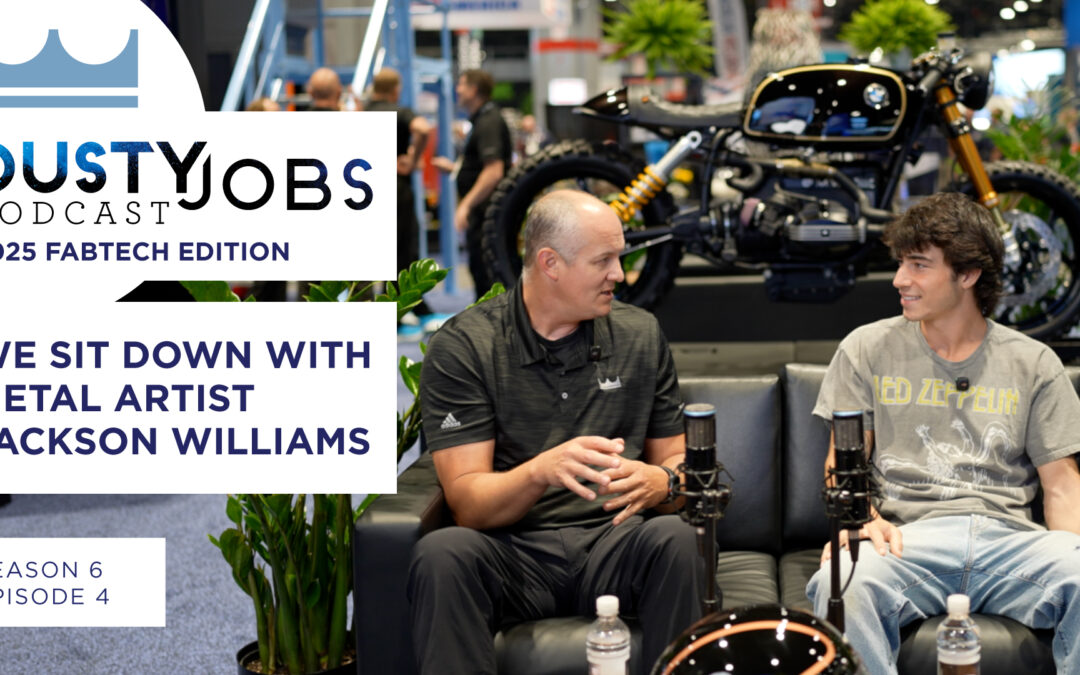
In this episode of the Dusty Jobs Podcast, we sit down with metal artist Jackson Williams at FABTECH 2025 in Chicago. Jackson is known for his large-scale metal sculptures of North America’s most iconic animals, including the impressive bear sculpture featured at our booth during the show. Jackson shares how he got started in metal art, the inspiration behind his work, and the creative process that goes into shaping raw metal into lifelike masterpieces. From learning the craft to building massive sculptures, his story is as unique as the art he creates.
Narrator: Welcome to the Dusty Jobs podcast from Imperial Systems. Industry knowledge to make your job easier and safer.
Donovan: Hello, welcome to another episode of the Dusty Jobs Podcast. We are back at FABTECH 2025 with Jackson Williams joining us here. How you doing?
Jackson: I’m doing great. How about you?
Donovan: Good. This is an exciting show for you, right?
Jackson: Very exciting. Yeah, I’m glad to be here.
Donovan: Now Jackson, tell us why you’re at our booth at FABTECH.
Jackson: Erin from your marketing department actually reached out to me a while back on Instagram and said, “Hey, we’d love to shoot a video of you at your space and bring it to Chicago for this.”
Donovan: Now when you say “your space,” not everybody here might be familiar with you. You’re talking about your art studio, right?
Jackson: My art studio, yeah.
Donovan: Okay. So what do you do — are you a painter?
Jackson: I’m a metal artist.
Donovan: A metal artist. That makes a lot more sense why we’re here at FABTECH.
Jackson: Yes.
Donovan: So this year for FABTECH, you made something for our booth. What did you make?
Jackson: I made a grizzly bear sculpture — a life-size metal grizzly bear sculpture.
Donovan: When you say life-size, how big are we talking?
Jackson: About 8 feet tall.
Donovan: Wow. That’s definitely creeping into life-size range. I guess those grizzlies get around 8 to 10 feet.
Jackson: Yeah. I would not want to encounter that in the wild.
Donovan: No, definitely not. But you can come to our booth at FABTECH and experience a virtual one. So let’s talk about how you built this, because the process is really interesting. We’ll have to paint a picture for people who aren’t able to come see it.
Jackson: It all starts with finding pictures online. I look for front, side, and back views of the animal I want to create. Once I find good reference images, I print them out and draw a grid on top. Then I use that grid to enlarge the image onto the floor. From there, I build my wire framing using thinner material — I work in ½-inch steel rods. That’s my medium.
I use thinner rods on the inside for the frame, building it all on the ground following my drawing. Then I stand it up, and the rest is basically “skinning” it with ½-inch rods.
Donovan: Got it. So first, you make a model on the floor. Then you take thinner material for the framing and rough it out.
Jackson: Right. I follow the image I’ve created on the ground, replicate it in material, weld it all together as one piece, and then stand it up. Once the front profile and side profile are in place, I start filling in the rest.
Donovan: So you’re almost weaving it together, right? Because the metal you’re using isn’t straight lines — it’s got curves.
Jackson: I try to avoid straight lines. I aim for subtle, flowing curves that follow the muscle structures of the animal. In this case, with the grizzly, the rods are all over the place to make it look shaggy — like the real thing.
Donovan: Absolutely. I’d encourage everyone to go online and look at the finished sculpture. It turned out phenomenal. I don’t even know — how many pictures do you think people took with it today?
Jackson: Several. Too many to count.
Donovan: I think at least 100 people stopped by to get their picture taken with it. It’s incredible.
Jackson: Thank you.
Donovan: Now, you haven’t been working in this style very long, have you?
Jackson: No, I’ve only been working in this style for about a year. I’m new to it, but I’ve been welding since I was six.
Donovan: Since you were six? Not a lot of people hand a welder to a six-year-old. There’s got to be a story there.
Jackson: My father is actually a metal sculptor as well. He taught me everything I know and got me welding at a very young age. Having access to a creative space meant I could create whatever I wanted. It started with go-karts and dirt bikes, and as I got older, it transitioned into art. I worked for my dad for about four years, soaked it all in, and then decided to try my own thing — and here I am now.
Donovan: We were talking earlier — your dad got started with custom motorcycles, right?
Jackson: He did. He was dabbling in art but also loved vintage motorcycles, so he was always fixing and riding them. He grew up in a machine shop with my grandfather, where everything was about rules and measurements. He wanted to go more in the direction of art, where there was more freedom.
Donovan: So you’re actually a third-generation metal worker.
Jackson: Yeah — possibly fourth. I’m not entirely sure, but maybe fourth.
Donovan: That’s an awesome legacy to continue. Now, when we look at your style compared to your dad’s, are they similar or very different?
Jackson: We really don’t have similar styles. But one thing he did teach me was how to frame out sculptures accurately. His method of drawing them on the floor and using a grid to enlarge the image is what I still use today. It’s a great way to make sure the sculptures look just how they should. But he works with bronze and has a much more realistic approach to his artwork.
Donovan: Does your dad work specifically with wildlife too, or is that more your thing?
Jackson: For the most part, he’s done a lot of animals — primarily horses, other animals, lots of dragons. I fell in love with that too. Capturing motion in these animals is challenging, but it’s also really rewarding.
Donovan: So we’ve got the bear here, and I saw in one of your videos that you did something like a deer mount too. Is that right?
Jackson: Yeah.
Donovan: Do you have any other projects out there we should know about or anything coming up you’re excited about?
Jackson: I just finished a Texas Longhorn — a little bigger than the bear.
Donovan: Full size?
Jackson: Full size. About 6 feet at the shoulders. The head was turned to the side, and one horn went way out. From the back leg to the end of the horn, it was about 14 or 15 feet. Next, I have a project of a hand holding a globe, representing a company called Ansell — a big glove manufacturer. It’s going to be their glove saving the planet.
Donovan: Nice. So you do commission work too — if someone comes to you with an idea?
Jackson: Yes.
Donovan: Was the Longhorn a commission or something you wanted to do?
Jackson: That was a commission I got off TikTok.
Donovan: That’s great. And the bear?
Jackson: The bear was me brainstorming ideas for what we could pull off in the space I was given for this event. I thought a standing grizzly would be so cool.
Donovan: And it does look phenomenal. Now, your dad’s shop is in Massachusetts, right?
Jackson: Yes — Essex, Massachusetts.
Donovan: But you moved your shop recently, didn’t you?
Jackson: Yes. I just moved to Asheville, North Carolina. I’ve been setting up a studio there, and it’s finally done. I’m super excited to get started.
Donovan: So if people are in Asheville and want custom artwork done, they should look you up. Actually, people from anywhere can, right?
Jackson: Yeah. Thanks to TikTok, people are reaching out from everywhere. Especially in North Carolina — it’s a big art community down there, and that’s part of why I moved.
Donovan: Well, it’s exciting to see what you’ve done here and what you have coming up. If there’s a young person out there watching this — maybe they don’t have the same family legacy you do, but they’re inspired by what you’re doing — what advice would you give them?
Jackson: Just start. Just do it. Try to find your style. I was first commissioned by someone in Michigan for a sculpture made out of parallel rods. I tried to improve on that style by bending the rods and giving them motion — and I fell in love with it. I kept doing it over and over, getting better and better at the one thing I loved. So find your style, work hard at it, and it will come.
Donovan: So it doesn’t happen overnight — you’ve got to put in the time. How much time did you put into the grizzly?
Jackson: A lot. About 300 hours.
Donovan: 300 hours! Wow. Now, if anyone wants to see more of your work or follow what you’re doing, where’s the best place to go?
Jackson: I’m on TikTok and Instagram. My handle is Williams Sculpture on both.
Donovan: Perfect. We’ll make sure to link that. And we have a video featuring you on our website too — it turned out great. If you want to check that out, you can head over there.
I’m just excited you’re here. You did a great job, and we’re looking forward to seeing what’s next for you.
Jackson: Me too.
Donovan: Thanks for coming on.
Jackson: Of course. Thank you.
Donovan: For everyone out there, like and subscribe, follow us on Instagram, on Facebook, all of our social channels — and until next time, stay healthy and stay safe.
Narrator: Thanks for listening to the Dusty Jobs podcast. Breathe better. Work safer.
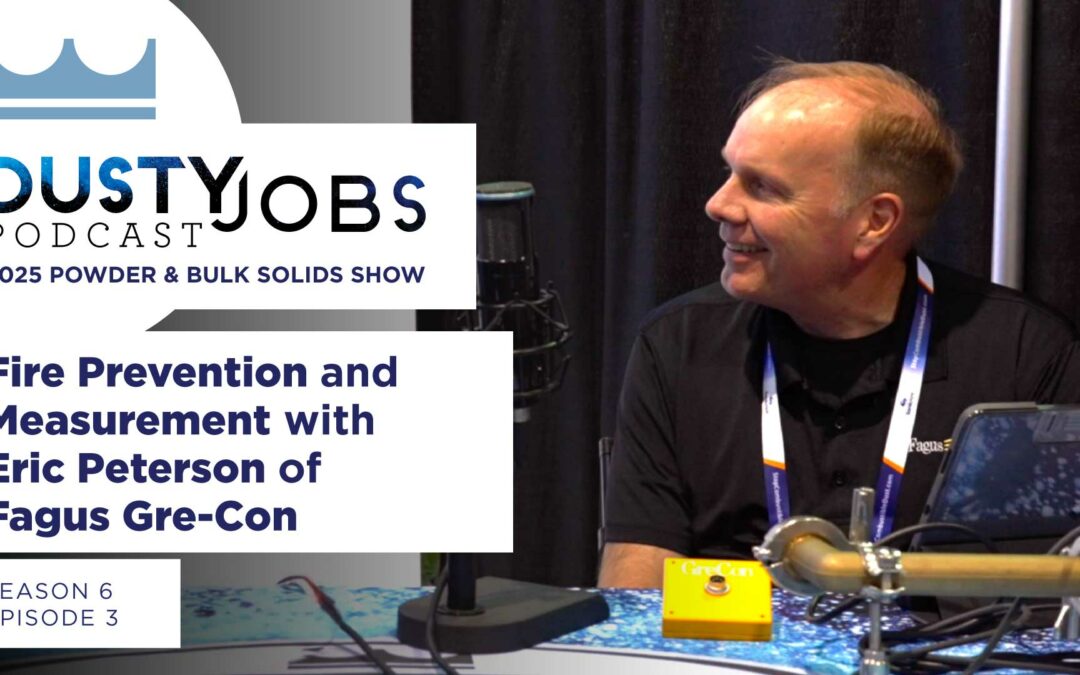
In this episode, Donovan chats with Eric Peterson of Fagus-GreCon live from the International Powder & Bulk Solids Show 2025. They discuss spark detection, fire prevention, and keeping industrial facilities safe. Learn more about Fagus-GreCon: https://www.fagus-grecon.com/en-us/
Narrator: Welcome to the Dusty Jobs podcast from Imperial Systems. Industry knowledge to make your job easier and safer.
Donovan: Hello and welcome to another episode of the Dusty Jobs Podcast. We’re still here at Powder & Bulk. Today we got Eric Peterson.
Eric: Yes.
Donovan: From Fagus-GreCon. I always, I always, I just call you guys GreCon.
Eric: Yeah, it’s much easier to say GreCon. It’s much easier. That’s what we tell people to say, too.
Donovan: But Fagus-GreCon. And you guys, we’ve worked with you a lot of times with protection devices/
Eric: Correct.
Donovan: And you’ve been with the company now for six years.
Eric: Six years.
Donovan: But you have been in this industry for a while, right?
Eric: Yeah, I’ve been in the wood industry for about 15 years. I’ve been with Huber Engineered Woods for a while and also on the powder side of things. I’ve been with General Mills, Pillsbury as well. So, I have a lot of experience in the industry, probably about 20 years now.
Donovan: Now I know for us we use a lot of your product on the wood dust side.
Eric: Correct.
Donovan: Because we build a product called a Spark Trap which helps in metalworking, and we get a lot of calls from people that say, “Hey, I’m having fires in my wood dust baghouse.”
Eric: Correct.
Donovan: And they want to put that spark trap on there. And we’re like, “You cannot do that.”
Eric: Correct.
Donovan: And that’s a lot of times when we’ll call a company like you guys.
Eric: Exactly.
Donovan: And for everyone out there who’s unfamiliar, maybe they are having this issue, they’re having continual events in their wood collector — what can you guys do to help with that?
Eric: Well, I think the one thing that we do is we try to detect sparks, embers, hot particles before they become a fire or an explosion.
Donovan: I gotcha.
Eric: That’s always a good thing. So, you know, for a baghouse or anything for a dust collector, we try to detect the sparks before they go in there so there is no combustion, no issues. And we do it all seamlessly while the operation is running. Never need to shut down. It notices a spark, sprays a little bit of mist, kind of smothers that spark, extinguishes it, and everyone just goes around and doesn’t know anything different outside of our console. We’ll say, “Hey, you had a little spark there,” just so you know — and more from the standpoint that they can keep the history to know do they have a problem in their previous process. Is there an issue they should pay attention to, or is it just kind of a random incident?
Donovan: So, like if every time it happens when you’re cutting this type of board — I don’t even know what it would be — this grinding application, then the sparks happen, like you can kind of correlate that together. Is that what you’re saying?
Eric: Absolutely. Or things you might not think about initially. Sometimes with wood, there’ll be metal pieces that get into the wood. So, if you get a run where there’s a lot of metal pieces, you might get a lot more sparks as they’re cutting or shaving or things like that. Or even in a dust collection system, you have a fan running.
Donovan: Right.
Eric: Fans sometimes can turn, bend, adjust, or a piece gets in there and all of a sudden it starts creating sparks. And if you have a big dust flow and you have those sparks blowing, it’s only a matter of time before something bad will happen.
Donovan: Especially if you don’t have a material handling fan. Sparks being directly introduced into the dust stream is not good.
Eric: Let’s just say that’s what we try to prevent.
Donovan: Right. So, not only do you guys do that, but you guys have a ton of good information on your website, too.
Eric: Right. Correct.
Donovan: So, I know you were showing me this earlier. It’s a little bit of a breakdown of what a spark is.
Eric: I think sometimes people don’t know. And I’ll turn it around — it’s not perfect for everybody to see — but there’s a lot of different types of sparks. So, you have your standard spark that’s just what you would think, like when you see metal hitting flint or something like that — seeing the spark — or a fan hitting metal. You have kind of burning particles that can happen in the process. And then there’s a couple of odd ones that are kind of hot particles, or we call them like glowing or burning nests.
Donovan: Yes.
Eric: And those are when materials get stuck in your ductwork.
Donovan: Oh, okay.
Eric: And they kind of start warming up, but they kind of have that charcoal over the top. So, it doesn’t look hot, but all of a sudden when enough breeze starts blowing, sometimes that’ll release into your process.
Donovan: Like when you’re blowing on a campfire and it just looks like charcoal and then it gets red.
Eric: That is a perfect example of what it is.
Donovan: Right. Gotcha.
Eric: So, there’s a number of different types here and we have different detectors that sense these things because they each have a different kind of temperature. We have infrared detectors that notice it at different levels. So, there is a lead sulfite detector that’s good for one application and there’s a different detector that’s good for another. Now, and I know when Todd was on a few years ago, we had talked about a new detector that we had, which is our DLD 19. It’s the yellow — the easier way to say it, it’s the yellow little detector.
Donovan: The yellow little detector.
Eric: It’s much easier to remember. But this detector actually sees on the whole spectrum of things. So, you no longer need a specialty detector. This one will work in the dark, in the light, or even if you have dark to light because it — we’ll just say it doesn’t look like an intelligent detector, but it’s an intelligent detector that adjusts the sensitivity with kind of an AI kind of thinking. It will see things differently as the light changes.
Donovan: So, there’s a lot of abilities in that little yellow box.
Eric: Exactly.
Donovan: So, if someone’s having incidents, probably an important thing for them to be able to tell you guys is what kind of sparks they’re generating, right?
Eric: I mean, a lot of times they don’t know what type of sparks. Most of them would say, “I don’t think we have any sparks,” right? And ours is just to look at their process. What are they doing? What are the potential points where they could have issues? What is the type of material? What type of handling system do they have? And then we’ll go in and help kind of dissect where our detection and extinguishing will make the most sense for them.
Donovan: So, what you’re saying is you don’t have to have it all figured out before you call you guys. You guys will help whoever’s having these issues figure out why they’re having them.
Eric: Absolutely. Our system is extremely customized. Unless you have the same process — like if you had multiple facilities — unless you have the same process, then it would be the same application. But everybody’s got a little different turns, a little longer runs, all these different things, and that changes how we might protect the area to make sure you don’t have those nasty fires and explosions.
Donovan: Yeah, because with your system — detect and then extinguish — there’s definitely some minimum distances you need between where it sees the spark and have enough time to put it out.
Eric: Correct. And that is affected by the type of material, the speed of the material — all those things change how far it needs to be from detection to extinguishment. And I think one thing, you know, when we say extinguishment, people are like, they think a fire hose. And we’re not doing a fire hose. When we do an extinguishment, it’s just a 3- to 4-second little mist. And because of the fan, the particles spray very evenly in a nice cone, and when the fan is blowing, those particles just spread across, fill the ductwork, and extinguish it all without really changing the moisture content of the material that you’re running.
Donovan: It’s not like the water parks where the big bucket dumps.
Eric: No, there’s no bucket dump. It’s just like a misty spray.
Donovan: And you guys know how long to let that spray and how much to spray in there so that it absolutely puts the spark out but doesn’t create a waterfall.
Eric: Yeah. Just basically a slight little bit of moisture — just a pop of water. And again, just so it spreads evenly throughout the area that it’s covering.
Donovan: Okay, let’s say I’m there. I notice I have these issues. I’m inside my building. Does it have to be inside? Can it be outside? Can I tie it into my sprinkler system or does it need to have its own direct water? What are our limitations?
Eric: Yeah, there’s one thing — you don’t want to tie it into your regular sprinkler system. One is a regular sprinkler system, when it’s activated, it’s going to let the fire department know that something’s going on. We don’t want to let the fire department know that a spark’s going off because we’re just going to put it out. There’s no incident. They don’t have to worry about anything. And we want the water charged to the nozzle so that when we detect, it’s instantly putting the water in. You don’t want a system where the water takes a few seconds to get to the nozzle. These nozzles are charged and ready to go, so they can immediately go off. Now, you can do it both inside and outside, but you do obviously have issues with freeze–thaw that could happen. We have blankets that you can put over our extinguishment devices and there’s also things like heat tape you can use to keep them safe. And we actually have a new extinguishment that also has a heat monitor in it. So it will sense the temperature and when it gets to a certain temperature, it will activate that heat chamber to warm up the device so it doesn’t freeze.
Donovan: Nice. So, we have this hooked up, we have it so it’s not freezing. How much pressure do I need to put a device like this in?
Eric: You know, again, it will depend on how many nozzles you have and what you’re trying to do. So, it will vary a little bit, but 60 PSI is what we’re kind of talking about.
Donovan: Okay. But if I don’t have that, you guys can help me with that?
Eric: Yeah, we have pumps that we can add to the system to make sure that’s happening. Most people, if they have a good water source, they’re going to have pretty close. Most of the time if you have good city water — not everyone has that good high pressure — but if you have good enough pressure that can be done. But it’s always easy to add a pump into the system. That way you don’t have to worry about when the pressure drops for any reason, like it’s 7:30 in the morning, everyone’s taking their shower in the city and the pressure goes down. This allows you to know that you have good, consistent pressure.
Donovan: Okay. So, now you mentioned how many actual sprinkler — or not sprinkler — heads. What do you guys call them?
Eric: We just call them simple extinguishment nozzles.
Donovan: Extinguishment nozzles. So, is it the larger the ductwork gets the more I need, or how do you determine that?
Eric: Really for general ductwork it’s about how big it is. So, the bigger the ductwork, we might add more. That makes sense. In most applications it’s two — one on either side. That way you get a good cone of distribution on either side. Because if you just have one on the top, it’s got a little blind spot right around that top. We don’t want any blind spots. We want good coverage from both sides.
Donovan: Gotcha. Okay, so now you brought some show and tell, too.
Eric: Yeah, I brought some show and tell. I’ve got more toys here than I probably need.
Donovan: If you’re listening, get on YouTube and check this out. What are we looking at here?
Eric: This looks like — yeah, it’s called our IEM. It’s an intelligent extinguishing module. I’m going to pick it up just for a second. So, it’s normally sitting like this. These are the nozzles down here. But it’s kind of awkward just to hold and I don’t have good bracing here, and I haven’t been lifting as much as I should have.
Donovan: Yeah, looks like you get a workout. It’s definitely a sturdy-built piece of equipment for sure.
Eric: But it’s a new module that helps us with a number of different things. It has some of the intelligent type of thinking that we had with the detector. First, it will help on the maintenance side of things. One of the most critical things in any spark extinguishment system is we detect sparks — we’re fantastic at doing it, we don’t miss them. It goes in there, we do a great job. The biggest challenge is our extinguishments work really well — as you were talking about low pressure — all of a sudden, “Oh, I was doing something, I turned the water off.” Oh. So now we detect, but the extinguisher isn’t working.
We want to make sure it’s always working. So, we have an extinguishment that does a couple of different things. One, it’ll tell you if your water’s on or off. Obviously, you can do that with a flow switch, which is easy to do. But it will also make sure that you don’t have leaky nozzles, or a nozzle that doesn’t have good flow — like a good cone shape. Because obviously if you have a nozzle and it’s only flowing out of half of it, that’s going to be a problem. Now we have a unit here with intelligence that’s up here that sees how that flow is coming out.
Donovan: Okay.
Eric: It can tell somebody on our console and it will say, “Hey, your cone isn’t quite right. You should probably change that nozzle.” Or it’ll say your nozzle isn’t quite closing, so there’s a little bit of water leaking. You might want to see if it’s broken or if maybe some material got stuck and you need to clean that nozzle. So, It does some intelligent things. And as I mentioned before when we were talking about heat, it also has a heat chamber in here that will sense the temperature and if it’s getting colder, it will activate that heat chamber to keep it from freezing.
Donovan: Keep it from fogging up.
Eric: Yeah. And again, it’ll give that message to the operator back at our console. It’ll tell you if it’s leaking, if your cone isn’t right, if you need maintenance. And obviously when you have all that information, you should be able to quickly adjust it. That way when we detect, your extinguishment is going to work perfectly.
Donovan: That sounds great because if you don’t have this on there, then you probably have to do manual annual PMs and get up there — and boy, that’s sometimes tough to check in.
Eric: Yeah. But we like to have everybody do an annual one anyway just to make sure everything’s working the way it should. But when you have a system that has a lot of dirt — we know not every one of these places has won the Good Housekeeping seal of approval as far as cleaning — sometimes they can’t get to places monthly to do the cleanings. This type of device is a huge maintenance and operational savings.
The other thing nice about it is it’ll give them that warning before there’s an issue. You don’t want to find out you have an issue when you have a ton of sparks that could cause a fire. You want to find out before —
Donovan: The smoke’s coming out of the baghouse, that’s the bad time to find out.
Eric: That’s definitely a bad sign. So that’s nice. And the other thing is you were saying about — and I didn’t mention it, and sometimes I forget about it with this device — is most of the time with most nozzles you’ve got to get your wrench and you’ve got to undo it. And when you’re up high or in an awkward spot, it’s hard to do. This has got just the simple quick release.
Donovan: Oh, that is slick.
Eric: You just need to unscrew it here.
Donovan: Oh, yeah. You unscrew it, unclamp it.
Eric: And you pop it off. Even guys like me can do it.
Donovan: When you make it easy for people to do, they’re way more likely to do maintenance on things when it’s easy — and not ignore an issue when a nozzle is not performing correctly. If you make it easy for them to fix it, that’s what you want. That’s what we want — we want people to be able to go home safe to their families and not be worried about coming to work. Doing things like this is definitely preventing a lot of hazards or potential things down the line.
Eric: Absolutely. I mean, that’s what I tell our team every day — we get the opportunity, the privilege, and the responsibility to make sure everybody goes home every day and sees their families. And it’s a big responsibility, but we have equipment that we know will deliver that. As long as we make sure it’s lined out appropriately and do the occasional maintenance on it to make sure everything’s operating well, we get to live behind that promise.
Donovan: And the other thing is, whenever a baghouse goes down, sometimes that stops production and people are losing money. They’re off their job for a while, they’re not able to…
Eric: Oh, absolutely. I mean, I think that’s one of the best parts about a spark system — we’re getting the spark out before it combusts.
Donovan: Right.
Eric: And by doing that, it all happens in line. There is no stoppage. Everything just happens like it normally would. Everyone can keep working. They acknowledge the spark just to know that it’s happening, as we talked about, in case there are issues. But you’re not worried about shutting down or anything like that — you just keep on running.
Donovan: Just keep going. Yeah. Well, that’s exciting. That’s really great stuff. So right now, what if I already have a spark detection and extinguishing system on it — can I retrofit to this or is this a whole new system?
Eric: Absolutely. No, it’s very simple to do. You just need to replace the old unit and put this one on. A replacement for an old extinguishment can happen just with basically this piece and one tiny little extension because this one is a little bit smaller — which is a good thing because nobody wants huge pieces of equipment. But the other thing is, if you have one existing, all you’ve got to have is a little small extension that’ll make it fit, and it’s a quick, easy change. You can put it in the exact same position.
Donovan: That’s great. So if everything’s already plumbed, everything’s already done, you can just —
Eric: Absolutely.
Donovan: Man, that makes it even easier.
Eric: It makes it easy and it’s a good part of an upgrade. And when folks are looking around, depending on the corrosive nature of the environment they’re in, you need to update your extinguishment periodically anyway. And in particular, I’m just saying if it was a fertilizer facility — this isn’t all stainless steel — but we have stainless steel options for this as well for applications that might be a little more corrosive.
Donovan: And that’s what’s great — you guys have already thought through all this. Somebody doesn’t have to figure this out. They can just come to you guys and you’re going to help them with the right solution.
Eric: Absolutely. I mean, we started in the wood industry. As a company, we’ve been around for 115 years. We’ve been doing sparks for 50. And the reason we got into sparks was we were in the woodworking business —
Donovan: Oh, there’s sparks there.
Eric: And like a good German company, we were creating our own sparks and we had to put these out. We had to figure it out. So we figured out how to do that and then the rest is history. We don’t do woodworking anymore and now we do the spark business, and we’ve been able to apply it to a lot of different industries. We started in woodworking. We’re in grain, flour, sugar, tobacco. You get into recycling — because if wires or bales get in there — chemicals, power plants, tissue, nonwovens, diapers, wipes, you name it. Anything that could potentially combust, we’re probably involved with.
Donovan: We always say if it’s a light and it’s a fluffy dust, that’s where you want to start going to active detect and extinguish.
Eric: Absolutely. And obviously anybody who’s on your side of things that are looking for any dust collection and they’re doing any of that work, having a system like ours tied into that just makes a ton of sense.
Donovan: So, what’s the best way for anybody out there who’s listening and thinking, “Man, I need to do something like this” — what’s the best way to get a hold of you guys?
Eric: I mean, always the simplest way for most people today is hitting the website. And I have to say the word for you: Fagus-GreCon.com.
Donovan: If you just type in — if you Google GreCon, it’ll probably still get you close.
Eric: The other option is they can always call our phone number, which is 704-912-0000. That’s easy too.
Donovan: Oh, there you go. And we’ll put some links, we can put all that stuff in there.
Eric: Oh yeah, which is great. We really appreciate it. And we’ve been doing business, I know, for a lot of years.
Donovan: You guys have helped us out with a lot of trickier dusts that are challenges, and you guys help us figure out how to handle those properly. It gives our customers a lot of confidence and comfort because you guys have this history and this knowledge base, and it’s not just throwing a product at them — you guys come in and help with a solution to what we have going on.
Eric: Yeah, absolutely. And we buy a few things from you guys — Abort Gates and things like that. That’s always a good thing and it allows for a good partnership. And as you said before, the goal is to make sure everybody goes home safely every day.
Donovan: Yeah, that’s it. Well, hey, I really thank you so much for coming on, giving us some time. This is an exciting product. So if anybody out there is having these issues, feel free to reach out to us. We’ll get you in touch with those guys. And until next time, stay healthy and stay safe, and we’ll talk to you later.
Eric: All right. Excellent. Thanks so much. Appreciate it.
[Music]
Narrator:Thanks for listening to the Dusty Jobs Podcast. Breathe better, work safer.
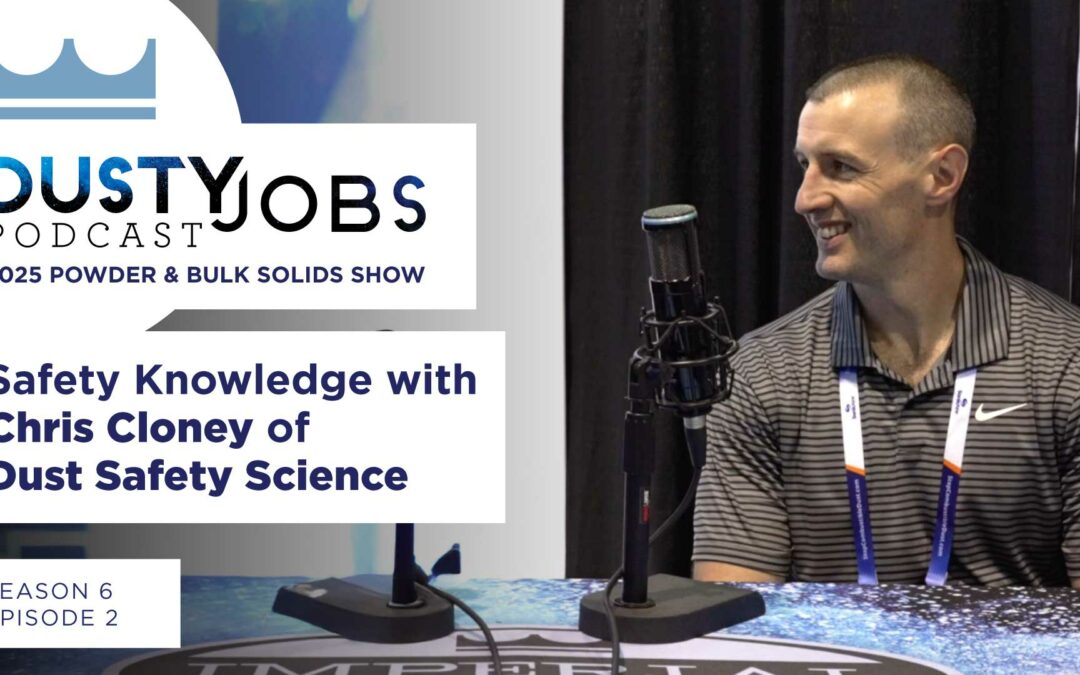
In Season 6 Episode 2 of the Dusty Jobs Podcast, Donovan sits down with Chris Cloney, founder of Dust Safety Science, at the International Powder and Bulk Solids Show. Chris Cloney discusses the new initiatives, including the Combustible Dust Training Institute (CDTI), which will offer training and certification programs in dust explosion safety. CDTI’s mission is to advance effective, efficient, and compliant combustible dust safety by creating comprehensive training and certification programs that empower individuals working in industries that handle combustible dust around the world.
Narrator: Welcome to the Dusty Jobs podcast from Imperial Systems. Industry knowledge to make your job easier and safer.
Donovan: Hello, welcome to another episode of the Dusty Jobs podcast. We got Chris back with us. How’s it going, Chris?
Chris: Doing awesome. I’m very excited.
Donovan: Yeah, so Chris, you’ve been, this is not your first time on our podcast. You’ve been here before. This is your, I think it’s your third episode with us.
Chris: Sounds right.
Donovan: Yeah.
Chris: Second time live at the Powder Show.
Donovan: At the Powder Show. Which is like, it’s great. I mean, with a lot of people this year, it seems like a really good show.
Chris: Yep.
Donovan: A lot of good stuff is going on. And you guys, you’re not just here talking this year. You actually have a booth this year, don’t you?
Chris: We do, yes. Our first time on this side of the table, I guess.
Donovan: Yeah.
Chris: We’ve presented a ton and presented this year, but we have an exhibition booth as well.
Donovan: Yeah, yeah. So you’re here with Dust Safety Science.
Chris: Yep.
Donovan: And you guys, so anybody who’s not familiar with what Dust Safety Science is, could you fill us in on a little bit more of what you guys do?
Chris: DustSafetyScience.com. We’re a connection platform for generating awareness for combustible dust safety, as well as connecting folks with experienced companies like yourselves. So, looking for dust collection systems, looking for vacuum systems, looking for people that provide dust hazard analysis services, explosion protection items. They got a problem with combustible dust. Dust Safety Science has a resource for them to come and actually learn about the problem, but then find folks like yourselves to work with.
Donovan: Yeah, and I know I’ve reached out to you in the past, even when I have some questions on things.
Chris: Sure have.
Donovan: And you find some people who, like, I mean, I don’t even know. There’s people who knew this stuff, but it’s great. You guys usually always come through and help find out, like, exactly what I need to know.
Chris: We get the tricky stuff, right? So, I say I don’t know the answers to everything, but we generally know who to ask. So, we call it our help desk. We, this, literally, on my phone right now, I have the list of tickets that are open. One of them is, you know, isolating munitions and pyrotechnics from explosions. There’s another one on, there’s several on metal dust and challenges with inerting or ignition sensitivity.
Donovan: Yeah.
Chris: So, yeah, when there’s a question people don’t know how to get an answer to, reach out there and help desk kind of get some sort of…
Donovan: I remember I emailed you one that was quite odd. It was, how much lime does it take to make this certain dust and dirt? And we figured it out. We, like, somehow, we found a person who had the formula and got the answer.
Chris: Unfortunately, it’s a lot. It is a lot. But, yes, we did get an answer.
Donovan: Yeah. Yeah. It kind of made it not a possibility to do that that way.
Chris: It’s not easy for me, but you can do the calculation.
Donovan: You can. You can.
Chris: Yeah.
Donovan: So, but…So that’s what, that is currently what the history of Dust Safety Science has been. And now, what, I mean, you guys are here, you’re presented. What’s new? What’s new with you guys?
Chris: So, one of the reasons we’re exhibiting is we have recently launched the Combustible Dust Training Institute.
Donovan: So, wait, wait, say that again. The Combustible Dust Training Institute. Okay, I’m with you.
Chris: CDTI.
Donovan: Okay.
Chris: The mission with Dust Safety Science was always to have at least one year with zero fatalities worldwide by 2038. Started in 2018. So, those that are counting were seven years in and we got, what, 13 years left?
Donovan: Yeah. Yeah. And I think we’re getting better every year.
Chris: Yeah.
Donovan: I don’t know if we’re there yet, but it’s definitely…
Chris: Quantitatively speaking, we haven’t hit a year with zero fatalities worldwide.
Donovan: Yeah.
Chris: But I think the awareness is getting better. There’s a lot of activity here in the US, but also globally, South America, Asia, Europe. So, that’s been coming along well. And our role in that has been connection platform, education, awareness through Dust Safety Science. One of the challenges was there’s no real pipeline for people to understand this stuff.
Donovan: Yeah.
Chris: Not necessarily the really detailed questions like you or other centers that help us.
Donovan: Right.
Chris: Just basic, what are combustible hazards? How do you assess them? What’s the right way to do dust collection system design installation? What’s combustible dust testing? What does that look like? What scenarios do we need to do more than the basic set of testing?
Donovan: Like the 101s.
Chris: Yeah. 101s and maybe 201s as well.
Donovan: Right.
Chris: It doesn’t exist. And so, that’s the goal for CDTIs to fill that void of having training programs for people to go through this stuff. All the way from basic, if you want to do testing, having an online on-demand program for understanding the combustible dust testing. Then we’re working all the way up to actually having certifications for being a certified dust safety professional or being a certified DHA leader. And those programs are bigger.
Donovan: Right.
Chris: 6-month, 12-month programs to get a real deep dive in knowledge in this sort of stuff. Also, exposure and experience in the industry so that when you come out with finishing that training, you actually know what you’re talking about. You know what you’re talking about anyway.
Donovan: Yeah. Yeah. But there is a lot of people who are coming straight out of college that are engineers. And they might be going into a facility, being a facilities engineer. And they get tasked with, you know, now you have this dust collector project. And they might have never learned at all about that the whole way through their college career. And these are educated people. They’re smart people. But that’s just an area they’ve never been exposed to. And you’re right. There’s not just a good resource as of right now to go, until now, to go and start to learn these basic things to educate yourself enough to make the right decision for the health and the safety of the people that are dependent on you to design something correctly.
Chris: Yeah. And there’s that side of the equation, just the, I’d say, junior staff and companies knowing, you know, knowing how to work through. We, because we run a help desk probably at least once a month, if not more, we get a call from consultants saying, “Do you know who we can hire? We’re looking to expand.” We get a call from equipment manufacturers saying, “Hey, we want young talent to know something about combustible dust.” Or, “We just hired junior staff and we want to train them up.”
Donovan: It’s not something your guidance counselor in high school said, “Hey, you know, there’s a career in exploding dust.”
Chris: And so there’s just no, and come on that with, we have a lot of older people that are kind of retiring out of combustible dust. There’s no pipeline of people. So that’s one of the founding things we’re trying to solve with CDTIs. Okay, how do we have a structured program? Maybe it’ll be a university set of course someday where we’ll work towards it. But let’s start with something where folks need to be trained up from knowing nothing to actually be able to go out and support these industries.
Donovan: Even basic vocabulary at time can be challenging at first. What is KSt? What is PMAX? How does that work? What are those means? How do I evaluate this? Not even knowing the vocabulary within this space can set its own set of challenges when someone’s reading a spec or someone’s trying to write a spec to get a bit out. So is that some of the stuff you guys are covering in this?
Chris: It is.
Donovan: When I’m looking at the 101 courses, walk me through a couple of what those are.
Chris: Yeah, so great question. The starting point is we have a certificate program, combustible specialist certificate. That’s a 10 hour on-demand course. We’ve had 80 people go through it so far. And most have finished it now and done the quizzes and got their certificate. So that’s sort of like the step one version.
Donovan: So if I would go into that, what would be some of the basic things I’d learn about?
Chris: So you cover it at a high level combustible dust testing, so identification hazards, the DHA process, so you understand how it works, not necessarily you can go and complete it yourself.
Donovan: So if I had that combustible dust test back, I’d actually read it and know what I’m talking about a little bit.
Chris: Interpretation of data is in there. Then high level on protection methods, prevention methods. It’s sort of, it’s not, we don’t have an awareness course, like a two hour, be aware, this is sort of, I’d say this is 101 level. We will have an awareness course because we haven’t created it yet. So this is enough to bring somebody up to speed, probably geared towards like equipment manufacturer where they want to be able to talk sensibly with their clients about this sort of thing.
Donovan: Right.
Chris: And know what they don’t know. So that’s the certificate program. Then we have a number of core courses within a curriculum that we’re developing. So a much deeper dive on testing, a much deeper dive on hazard prevention and mitigation systems, interpretation results from dust hazard analysis, management systems, like housekeeping, management of change, that sort of thing. And a couple other programs that we’re building out. And if you combine that with this certificate, that’s what the certification is that we’re building towards.
Donovan: Gotcha.
Chris: So to get that certification, then you do all the core course requirements. You have some electives you can specialize in. There is an exam at the end of the six month period. It’s not small, 200 multiple choice questions.
Donovan: Holy moly.
Chris: But it’s not meant to be a walk in the park. It’s also not meant to take six days to get through. And that’s some experience, experiential learning requirements on the job stuff. And that gets you through that certification.
Donovan: So what would be some of those experiential learning?
Chris: There’s two kind of flavors. If you’re working in a job where you’re actively handling the bustle dust on a day to day basis, that’s probably going to be able to fill those requirements.
Donovan: So if I’m in a Powder & Bulk situation such as a wood factory or a grain facility, probably just interacting with what’s going on there would handle that?
Chris: A lot of the time we’re still working through the committee to be able to evaluate experiential learning and what works and what doesn’t.
Donovan: Yeah.
Chris: But generally, if you’re working with the dust collection company, you have jobs where you’re specifying equipment, that’s a really good experiential learning opportunity. If you’re a health and safety manager and you’re taking the program and you have some combustible dust on site, but you’re taking it just, you know, you’ve had your DHA done by an outside expert and you’re not really involved with projects, we submit projects for those folks, we provide learning opportunities for them. There might be a case study of an incident that happened. You have to back rewrite what a DHA might look like for it.
Donovan: Gotcha.
Chris: There’s a case where if you can’t get that learning experience on your day-to-day job, then we’re providing those learning opportunities for folks. Because we want to be able to do both. We want you guys, we want equipment providers to be able to go through the program, get value, but also then health and safety folks, occupational health and safety, industrial hygiene, so they can step in and be that SME, that subject matter expert for their company to interface with folks that are helping them.
Donovan: So if somebody’s out there and they’re looking on the internet right now and they’re trying to find, they got tasked with the first time their company is going to be dealing with a combustible dust situation.
Chris: Yeah.
Donovan: By the end of this six-month course, they’d probably be pretty well set to be able to evaluate anything that’s coming in, how to actually look at the products that they need to purchase, how to talk to the equipment providers about,
Chris: Right
Donovan: I mean that’s the goal of it?
Chris: It is. Yeah. There’s two programs, there’s a certified DHA leader and then there’s a certified dust safety professional program. That kind of flavors kind of towards the certified dust safety professional.
Donovan: Gotcha.
Chris: There is a DHA leader program as well, which is a bit different. But the certified dust safety professional, it’s really about interfacing better. So when you get quotes for a bunch of exposure protection equipment, you know enough to be able to assess, is this the right protection, does this make sense?
Donovan: How to ask the right questions.
Chris: Yeah. You know, who do I go to if I need to understand the dust collection system. We need to do grounding and bonding. Like, it’s more about being that subject matter expert point of contact within your company, so you at least have somebody that can do that.
Donovan: Right.
Chris: The DHA leader program also has some elements on top of that about how to lead and facilitate the hazard analysis process. How to build a team. Who to look for to bring into that team. How to actually run site assessment. How to do the reporting afterwards.
Donovan: Yeah.
Chris: That’s kind of where you get in with. If you do a CDSP program, you shouldn’t really be set into the wild to start doing hazard analysis and hazard assessments yourself. There’s more training and experience and requirements on top of that.
Donovan: But if you did the, what was the first one?
Chris: CDSP.
Donovan: You probably would have a better understanding on how to read your dust hazard analysis.
Chris: Exactly.
Donovan: When you have someone bring it back to you.
Chris: Yeah, exactly. And it’s a big challenge. Like, people go get a DHA done today. Some DHA providers are better at this than others. Some will walk through and help them understand. But others just get the paper and they don’t know what to do with it.
Donovan: Right.
Chris: So if you’re a certified dust safety professional, our hope is that you’ll know what to do with that when you start actually making your facility safe.
Donovan: Yeah, because that’s the whole goal of the DHA is that in the end, you have a safer facility.
Chris: That is the goal.
Donovan: That’s the goal. So that people can go home to their families the way they came to work.
Chris: And we can get closer to our mission of one year zero fatalities worldwide.
Donovan: Yeah.
Chris: Because we can’t if the facility doesn’t actually get safer at the end of the day.
Donovan: Right. Right. And there’s, like you said, I think there’s a lot of people out there that might not even know at this point that they’re dealing in a facility that’s not 100% up to where it should be.
Chris: So we have three levels on what we kind of explained through. We’re trying to make facilities compliant. Well, try to help facilities implement compliant, effective and efficient combustible dust safety programs.
Donovan: Yeah.
Chris: So step one is, okay, how do we get to compliance?
Donovan: Right.
Chris: Step two is, is it actually effective? So there are some areas, you know, if you have a really simple facility, compliance might keep everyone safe.
Donovan: Right.
Chris: You have a more complex facility. Okay, compliance. What do we need to do on top of that to actually have an effective safety program? And then efficient. How do we have an efficient safety program? So are we spending our safety dollars wisely? Are we getting a good return on our safety dollars spent?
Donovan: Yeah.
Chris: Are we over protecting here where if we did a risk assessment, maybe we were able to take that protection scheme, that base of safety, and go with something that’s not over protected and spend that money elsewhere in terms of safety programs training, whatever.
Donovan: Because if it’s not all of those things, then it might end up failing in the end.
Chris: Yeah.
Donovan: People won’t stay with it. People won’t do it.
Chris: Yeah. We call them mature. Like, I’m thinking of a really mature safety system or organization has really mature safety. They have all those elements, right? They’re in compliance.
Donovan: Right.
Chris: They have an efficient safety program. It actually stops you from getting hurt.
Donovan: Right.
Chris: And they have an, or that’s effective. And they have an efficient safety program. They’re being wise with how they’re investing their safety dollars every day. That’s what good looks like. I’m sure you’ve seen various phases of that.
Donovan: I have. I’ve seen good to nothing.
Chris: Yeah. So, you can be any, and we’re just trying to, okay, here’s how you build up that compliance, effective, efficient. And if you skip the step, if you try to do efficient before you are effective or compliant, it doesn’t, a lot of people try to go to that route. It doesn’t work all that well. Same thing if you try to, you know, if you try to make it effective, but say, yeah, we know better than the NFPA 664. So, we’re going to do it this way. And you just guess and leave some stuff out and you’re not in compliance. Maybe you can do that, but in a lot of cases, you’re only leaving out because you haven’t experienced a loss that has driven the change in the requirement that came in the first place.
Donovan: Right.
Chris: So, it’s advisable to start with compliance, then move to effective, and then make it efficient after that.
Donovan: Yeah. Yeah. That’s a great model for making it for you.
Chris: I’ll be presenting that next year at Powder and Bulk Solids. I don’t know yet, but maybe I’ll pitch it to them.
Donovan: So, but, okay, so if someone’s interested in signing up for one of these classes, being part of that, how do they do that? How should they reach out? I mean, do you just Google this or what’s the best way to do it?
Chris: The best way is just to go to dustsafetyscience.com, and you’ll see there’ll be a button or tab somewhere that’s training.
Donovan: Okay.
Chris: Eventually, it’ll be more prominent on the site if it’s not already. And that’s the best way. You can always reach out to me, Chris, at dustsafetyscience.com. We run our own podcast.
Donovan: Yeah, you guys are going to respond to information on there.
Chris: And if you’ve got a question, like, training side, do you want training? Do that.
Donovan: Yeah.
Chris: If you’ve got a question, you’re stuck, you can’t figure something else out, just do the same thing. Go to dustsafetyscience.com and ask us. We don’t know the answer. Chances are we know the person that does.
Donovan: You know a guy.
Chris: And if we don’t, then chances are we don’t have an answer. You might need to ask a better question. We’ll work on it.
Donovan: Yeah. So, are you looking at me, Chris, so I need to ask better questions when I send them to you? No, it’s all right.
Chris: There’s a distribution of users for our help desk from little to lots and Donovan is on the other side of the curve. So you have to use it quite a bit, which is good. We appreciate it.
Donovan: Yeah. So, yeah, I appreciate it too because usually I only get these questions when I come to you when people are trying to make their facilities better and safer. And so if I had to come to you with something, Chris, I always, for me, it’s great because people aren’t just ignoring issues anymore. And we’re actually asking hard questions as opposed to just kicking that can down the road to where, well, we’ll just wait and see what happens. And I don’t think that’s really a good answer.
Chris: I agree.
Donovan: Yeah.
Chris: Thanks for having me on. So I look forward two more years to do another one of the next steps.
Donovan: Yeah, there you go. There you go. So, hey, thanks for everybody for listening. Check out Chris at Dust Safety Science and check us out on YouTube, Instagram, all those social media feeds, like and subscribe. And until next time, stay healthy and stay safe.
Chris: See you.
Narrator: Thanks for listening to the Dusty Jobs podcast. Breathe Better. Work safer.
We’re kicking off the new season at the International Powder and Bulk Solids Show in Chicago 2025. In our first podcast episode, Donovan sits down with Marc Hodapp from Fire & Risk Alliance to discuss Dust Hazard Analyses (DHA)—what they are, when you need one, and what to do once you’ve got your results. They dive into key metrics like KST and PMAX for combustible dust, and Marc shares how Fire & Risk Alliance can help interpret these values and guide you toward the right safety solutions. To learn more about Fire & Risk Alliance visit: https://fireriskalliance.com
Narrator: Welcome to the Dusty Jobs podcast from Imperial Systems. Industry knowledge to make your job easier and safer.
Donovan: Hello and welcome to another episode of the Dusty Jobs podcast. We’re here at Powder Bulk. It’s an interesting, it’s a great show.
Mark: It’s been a great show so far.
Donovan: Joining us right now is Mark Hodapp. Did I say that right?
Mark: You did.
Donovan: Fire Risk Alliance, right?
Mark: That is correct.
Donovan: Fire Risk Alliance. So, we’re here. We saw you guys’ last time at the show. This isn’t your first show. You guys come to this all the time.
Mark: Yeah, we’ve been here quite a bit. We had a couple of years off there but were happy to be back and see everybody.
Donovan: Well, I think everybody took a couple of years off during COVID it seems like. But the show seems like there’s a ton of people out this year. I’d say if anybody’s out there thinking about coming next time, great time. Lots of great booths.
Mark: Yeah, I mean, I think we’ve been talking about it ourselves internally, and we want to make sure this is an annual thing for us.
Donovan: Yeah.
Mark: There’s a lot of great people, a lot of great conversations, good networking.
Donovan: So yeah, yeah. So, one of the reasons you guys are here is because of powder bulk, I mean, it’s really the explosive dust show, right? Isn’t that what you’d say? Like, come here, you can learn a lot about it.
Mark: We learn a lot. I mean, for us, you know, in our field, we deal a lot with combustible dust and industrial and manufacturing.
Donovan: Right.
Mark: You know, our company certainly does other things, but myself, that’s what I specialize in.
Donovan: Yeah.
Mark: And so for us, we get to meet everybody who manufactures the equipment that our clients use to understand what’s out there, what we’re going to see in the field.
Donovan: Yeah.
Mark: Um, get to learn about what’s new and in all the fire and explosion protection and dust collection.
Donovan: People are making new products all the time.
Mark: That’s right.
Donovan: Trying to make things healthier, safer for people who are out there working with some of this dust that’s potentially very dangerous.
Mark: Yeah, that’s and for us, you know, it helps to have a good network to, you know, we’re analyzing and understanding what the hazards are and working with our clients to mitigate those hazards and it’s helpful for us to know who’s out there and what equipment’s available that we can recommend to make them safer.
Donovan: Right. So, and that’s really the backbone of what you do, right? You’ve been doing this for how long now?
Mark: About 16 years.
Donovan: 16 years. This is not your first rodeo.
Mark: It is not. We’ve done somewhere on the order of 300 dust hazard analyses.
Donovan: Wow. We’ve talked about before dust hazard analysis. That’s a new thing. The government’s mandating it. So, give me 10 seconds on what a dust hazard analysis is and what you guys do with that. So, anybody out there who’s never heard of it.
Mark: So, really a dust hazard analysis is to understand if you’re handling combustible dusts.
Donovan: Okay.
Mark: And if so, understanding what their hazards are, the actual material hazards and then in your facility understanding what equipment is handling that dust and if there’s fire explosion or flash fire hazards associated with that and same thing in the building. Do you have any future dust? Where does that go? Do you have fire, flash fire and explosion hazards?
Donovan: So, it’s more than just an evaluation of the dust. It’s an evaluation of the full facility and how that dust interacts in that facility. Is that a good way to put it?
Mark: That’s a good way to put it. And you know, the key is really understanding what hazards exist and then how you manage those hazards.
Donovan: Right. And what’s happened over the years. When you go back and you look at some of the large explosions or the large losses that have occurred and still occur, we’re doing better as an industry.
Mark: Yeah. One of the key gaps that’s been identified is people just don’t understand they have these hazards. They don’t necessarily know they have combustible dust.
Donovan: So, what are some of the…So, you’ve done 300 of these. What’s some of the things you’re seeing that’s like most common amongst people that you’re like, you should make sure that that is some… If you have this in your facility, you should have somebody come check it out to see if it’s a potential hazard.
Mark: Yeah. I mean, I would say almost every industry we’ve worked with has combustible dust somewhere.
Donovan: Right.
Mark: If you’re handling bulk solids, particulate solids, you may very well have combustible dust. Anything that is organic is going to generally produce combustible dust, metals. So, a lot of times people don’t understand that their dusts are combustible. More often than not, they are. And even industries like you wouldn’t think of like concrete production. You say concrete stone. There’s no way there’s combustible dust in it. There are combustible additives added to concrete mixtures.
Donovan: Yeah.
Mark: And so, a lot of times I’d say, you know, if you’re handling bulk solids at all, you should really do a dust hazard analysis. That could be as simple as just saying, “we’ve looked at this, we don’t have any combustible dust. We can stop there.”
Donovan: So, okay. So, besides just calling an organization like yourselves, what’s step one to getting that dust? I mean, is it getting your dust tested? Is that step one or is there a step before that? I mean, tell me where I should start. If I’m thinking, I need to get this checked out. What’s the first thing I should do?
Mark: So, generally speaking, I think a good starting point is to kind of gather an inventory of what you’re handling.
Donovan: Okay.
Mark: You can kind of start with an initial screening looking at like safety data sheets, but they’re unreliable in terms of the information that’s on there.
Donovan: Okay.
Mark: There are some websites you can go to that have publicly available dust data. There’s a website hosted by basically Germany’s Virgin of Osha.
Donovan: Okay.
Mark: It’s called the Guestess Database. They have about 7,000 data points that you can go browse through. And so, if you find your dust on there and it’s explosible, it’s a combustible dust,
Donovan: Yeah.
Mark: That’s a pretty good initial screening. And then from there, testing is an important step, but a lot of times that’s where I say it’s good to engage somebody, whether it be internal or consultant externally like myself, to kind of help work through all right, we think we have combustible dust, or we know we do. What’s the best way to test?
Donovan: Okay.
Mark: Because you don’t want to just go out and send any old sample off for testing. You may not get the data you need.
Donovan: No, just put it in a paper baggage or facility and light it on fire, right? You got to…there’s proper ways to do this.
Mark: There’s proper ways to test and also proper ways to sample to make sure that you’re getting good value out of the testing that you do.
Donovan: Okay. So what…okay. So if I’m getting a dust sample together, what’s the proper way to do that? I mean, do I just go to…If I have a dust pointer, I just go to the bottom of it and then scoop up whatever? Do I sweep it off the floor? What am I looking for here?
Mark: That’s a good question. And it really kind of depends what you’re trying to understand about your dust. So if you’re in a facility, let’s say you’re making gypsum board.
Donovan: Okay.
Mark: Gypsum production involves a lot of gypsum, which is non-combustible, but they also use starch and sugar.
Donovan: Yeah.
Mark: And so if you’re trying to understand, it can be quite dusty. So if you’re trying to understand, do I have building deflagration hazards, you might be interested in sampling some of the dust off the floor, but you want to make sure you’re taking it from a location, maybe closer to where you have your starch or sugar.
Donovan: Okay.
Mark: And so sometimes it’s appropriate to sample from surfaces or floors. But if you’re saying, “Okay, I need to put in a new dust collection system. How do I know if I have muscled dust? How do I size my explosion protection?” Then it could be good to take samples from a drum of an existing dust collector, for example, that’s going to be replaced.
Donovan: Yeah.
Mark: So, where you sample, how you sample, understanding the composition of materials. If you are in a process where you have different batches or powder blending facilities, you may have hundreds or thousands of different recipes.
Donovan: Oh, that’s true.
Mark: And so you look through your recipes and say, “All right, what do we know about these materials?
Donovan: So Monday might not be too bad, but whatever you’re mixing on Wednesday, kaboom!
Mark: And that’s why I recommend the earlier you have someone who’s had some expertise in this, whether internally or externally, it’s good, because dust testing is relatively affordable, but you want to make sure you’re still getting your money’s worth out of the test.
Donovan: Yeah. Yeah. And that’s where guys like you who have been doing this for a long time can help make sure you’re not wasting your time, wasting your money, getting things tested that you don’t even need to get tested, or maybe getting back the wrong results.
Mark: That’s right.
Donovan: Because I know for us, that building dust collectors, the KST scale is something that is tricky for people to understand it.
Mark: Yes.
Donovan: Because a KST of zero…Means you don’t have an explosible dust.
Mark: No problem.
Donovan: But you have a KST of five…
Mark: With some gray areas, it could still be combustible dust.
Donovan: Right.
Donovan: But then if you have a KST of 150, you have a KST of 202, that even though that doesn’t seem like that’s that big of a jump, that scale makes a difference…On our side, I know, makes a difference on how you protect that dust collector.
Mark: It does. And that’s a good…I mean, two points there I think are important is one is KST and P-MAX, which is what a lot of folks think of when you think about dust testing and what comes out of it. Those are important numbers. And they are a big driver on explosion, system sizing, and design. But they’re only one indication of a hazard. And that’s kind of a misconception I see a lot. I’ve had a lot of clients I’ve worked with over the years that said, “Well, we only have a KST of 60 or 45. We’ve been told in the past that we don’t have to worry about that.”
Donovan: Right.
Mark: “It’s very mild. We don’t have to worry about that.” And there are other properties of a dust that can make things uniquely hazardous, like how easy it is to ignite.
Donovan: True.
Mark: You may have a dust as a KST of 100, but a very low ignition energy. That dust is probably going to have a much higher likelihood of actually having an incident than another dust with a KST of 80 or 140, rather a higher KST, but a very high ignition energy.
Donovan: Yeah.
Mark: And so I think when you look at where accidents actually occur and where the risk actually is, the KST is one piece of the puzzle, but it doesn’t give you the whole picture.
Donovan: Right.
Mark: And similarly, you may have certain situations where a dust is not explosible, but could still present a fire hazard.
Donovan: Oh, yeah.
Mark: And so maybe you don’t need explosion protection, or maybe you added it as an abundance of caution, but maybe your fire protection considerations are still important.
Donovan: Right.
Donovan: I always like to use wood as the example. It’s great for that because sawdust is way different than a 2×4.
Mark: That’s right. Which is way different than wood flower.
Donovan: Right.
Mark: Or what you get from sanding MDF.
Donovan: Exactly. So because those are, you know, you’re dealing with one dust that is still, you know, I might have a 2×4 laying there. That’s a definitely fire hazard. It could potentially catch on fire.
Mark: It’ll burn.
Donovan: But you have wood flower. It could burn, but it can also explode and feed to a lot more harm.
Mark: That’s right.
Donovan: So, Yeah. So you guys can come in, start taking those data points, and then for a DHA, you are going to compile. Do you get a report at the end? What’s the end result?
Mark: Yeah. So kind of we like to think about combustible dust hazard management is really kind of a life cycle.
Donovan: Okay.
Mark: DHA is usually a first step.
Donovan: Gotcha.
Mark: And so what our deliverable for a DHA is is usually ideally we’d be involved early on to kind of help guide the testing and sampling project, part of the project, and then usually our deliverable is some sort of a report depending on what stage the project’s in.
Donovan: Gotcha.
Mark: And what that really does is that creates a clear picture for our clients of where their hazards are.
Donovan: Andthat’s on maybe a new construction or replacement of a collector?
Mark: That’s an excellent question. I mean, I kind of think of DHA’s in three phases. A lot of times it’s a retroactive requirement.
Donovan: Right.
Mark: A lot of times you can be doing a DHA on an existing facility, and you’re going to be finding gaps generally for things that were installed a long time ago or may have been grandfathered in.
Donovan: Right.
Mark: But there’s still kind of a general requirement to mitigate risk to the extent possible or identify action plans for what you do over the next five or ten years. Plan your future projects, plan equipment upgrades.
Donovan: Yep.
Mark: To bring yourself into compliance and a higher level of safety.
Donovan: Right.
Mark: We also do a lot of DHA’s as part of new projects.
Donovan: Yep.
Mark: And I always say if you’re doing a DHA as part of a new project, that’s where you have the most value. Because it’s relatively straightforward and you’re also making sure that your design works well from a safety standpoint and the performance standpoint. Is your dust collection going to work with you and what you need to do as your facility or process grows to make sure you have long-term combustible dust management?
Donovan: Right.
Mark: Are you right sizing your safety systems? Do you have the most… Are you putting your dust collector in the most optimal location?
Donovan: Right.
Mark: For performance and safety?
Donovan: Yeah, and cost.
Mark: And cost.
Donovan: Yeah, because if you put something in the middle of a facility, that has a much higher cost than if you were able to locate that outside of the facility.
Mark: Yeah.
Donovan: Yeah. So, all right, let me ask you this. Say I have a brand new project and I don’t have any dust yet from my thing. Could you guys help me try to figure out how I can protect my collector properly?
Mark: Definitely, and it happens. I mean, we’re working on several right now.
Donovan: Yeah.
Mark: And that’s great.
Mark: So, the more new DHAs we do for new projects, the happier we are.
Donovan: Right.
Mark: It means everyone’s staying ahead of it. But the short answer is yes. It depends on the process. You know, if it’s an R&D application or new product, a lot of times the materials that they’re going to be handling or the formulations, I’ve already been developed.
Donovan: Right.
Mark: At a lab scale.
Donovan: Yeah.
Mark: So, a lot of times we can work with our clients and they can create samples from a lab that are representative of what they’re going to be doing. Other times, you may not know exactly what the composition of your dust is or exactly the particle size, but you can bound your design. And so, for example, take something like wood.
Donovan: Yeah.
Mark: Common material.
Donovan: Right.
Mark: We don’t necessarily need to test that in all applications, especially if you’re picking out a new dust collector. If it’s sized for ST1 dusts, then you’re covered up to a KST of 200 PMX of say maybe 5 bar.
Donovan: Right.
Mark: You’re going to be well covered for pretty much any type of wood you’re using.
Donovan: Yeah. Unless you have something really crazy.
Mark: Oh yeah, or if it has additives in it or various things, you know, composites, for example.
Donovan: Right.
Mark: Maybe throw a wrench in that.
Donovan: Yep. Yeah.
Mark: But you can work through that and you can usually design with the safety factor to account for that.
Donovan: And probably come into an organization like you guys, who have so much under their belt already, you’re going to be, there’s a chance, a decent chance, you’ve already ran into a similar dust that you can at least compare it to.
Mark: That’s right. I would say another thing that we’re seeing more of, and it depends on the state and jurisdiction, but we’re seeing more input from fire code officials and building code officials, where they’re saying, I mean, for a long time, if you’re going to put in a sprinkler system or you’re going to design a building, you need fire protection drawings, you need stamped architectural set for permit. We’re more frequently seeing fire code officials saying, I need my dust collection drawings or my explosion protection drawings reviewed and stamped by a professional design, by a design professional.
Donovan: Yeah.
Mark: And that’s something we’re all registered engineers, we’re registered in all 50 states.
Donovan: Nice.
Mark: And that’s something as well. If you’re doing a DHA as part of a new project, that gives you all the documentation you need.
Donovan: Right.
Mark: Not just for the building design, but for also the equipment that goes into it.
Donovan: So we’ve been talking a lot about new projects. But I gotta imagine that some of the biggest challenges is that dust collector that’s been out there for 30 years.
Mark: Yeah.
Donovan: It still may be running fine, but 30 years ago, it didn’t need to have the same protections, or maybe there wasn’t as much of an awareness of what needed. And now people are coming back, their insurance companies telling them stuff, and they got to start to unpack how they’re going to tackle that. Now, is that an area you guys can help with too?
Mark: It is, and we do a lot of that. I think existing facilities are spot on, present some of the most difficult challenges, because it could be a situation where someone is mandating that you do a DHA, like you said, and ensure that may not be something that you had planned for that year. And so, one of the roles that we help to serve is to help kind of evaluate those existing conditions. There’s things that can be done on pretty much any existing system to help mitigate risk, low hanging fruit, things you can do maybe for ignition source control, duct balancing, bonding and grounding, kind of managing things, or certain things you can do very low cost to start mitigating risk on day one.
Donovan: Right.
Mark: And a lot of times what we do with our clients is say, “Alright, let’s take a look at what you would need to do to bring this into compliance, or really manage the hazards that you have. Does it make sense to try to retrofit your existing equipment?” Sometimes you can. And we can work with them to size their exposure protection, install the right specifying and size their fire protection upgrades appropriately, and kind of help them understand what the costs and implications of that would be.
Donovan: Yeah.
Mark: A lot of times what you end up finding is it’s actually more cost effective to plan for and properly design and install a new dust collection system.
Donovan: Yeah, and I talk to a lot of people too, and that’s the same challenge they’re at. You know, they’re at this fork in the road, and they’re trying to do a budgetary analysis to see if they are…What they have is worthy and/or capable of being upgraded, and what the costs are associated with that. And it’s nice to know that there’s people out there that are third party. They have no skin in the game. They’re just trying to make sure people are getting home safe to their families.
Mark: Yeah, I mean for us, our goal is making sure that we’re protecting our clients and their people and their facilities and their business continuity. And we’re really in the business of providing the best objective advice that we can.
Donovan: Right.
Mark: But we also are advocates for our clients, right?
Donovan: Right.
Mark: And I think there’s a really good example. We worked on a project this past summer where they had a dust collector that was probably within five years of the end of its life anyway, had to be replaced, they had to be insured, that said, “Hey, you have to do this DHA.”
Donovan: Right.
Mark: And they had a lot of gaps in their fire and explosion protection. And we were able to help them come to a solution where we identified four or five things they could do at low cost to mitigate their risks substantially, modify their process and dust collection a little bit to maybe remove some of their higher risk items. So for example, they had some belt sanders that were used infrequently, but they produce a lot more sparks.
Donovan: Right.
Mark: And we say, “Hey, do you really need this here? Do you really need this now? No, we don’t. We can live without this short term.” And we kind of helped work with them and their insurer to say, “All right, here’s the plan for what we do this year.”
Donovan: Yeah.
Mark: And we think that this gets them to kind of as low as reasonably possible risk position for them to start planning for a new dust collector.
Donovan: Right.
Mark: And it turned out that that was everyone was in agreement, and it gave them five years to really budget for and plan for the new dust collection system that was not only safe and compliant, but got them where they needed to go.
Donovan: Yeah and in the meantime, as opposed to just putting it off, they’re doing everything they can in that situation to make it safe.
Mark: That’s right.
Donovan: As it can be.
Mark: Yep. Which is, that’s great.
Donovan: Yeah, that’s what everybody wants. Everybody just wants to have a safer work environment, try to help people.
Mark: Exactly.
Donovan: Yeah, have a really, not feel worried when you go to work. You want to be able to just go and do your job.
Mark: Exactly. And I mean, you know, we all understand, I don’t know that every, you know, on the codes and standards are developed.
Donovan: Right.
Mark: But those of us that are out there, either in industry or practicing, we understand that there’s real world constraints, there’s cost implications.
Donovan: Right.
Mark: But by and large, everyone wants to do the right thing.
Donovan: Yeah.
Mark: And so I think, you know, finding pragmatic solutions, working with those in industry that have good solutions for retrofits and offer, you know, new and improved and current and compliant systems and kind of putting everybody together is something that we really enjoy doing.
Donovan: Yeah. And if you’re in that situation, I would say, you have the opportunity to come to a show like this. Boy, this is like just a goldmine of finding solutions and ways that you can do that. If you’re an engineering firm out there and you’re looking for some guidance, contacting guys like you could really help get this stuff into your customers’ budgets ahead of time on new projects, you know, get that design knowledge of people who’ve been in the field for a long time. A lot of people who are doing engineering work, structural engineers think that, you know, they’re not living it every day like you guys are. And they could probably miss something on accident. They don’t even mean to.
Mark: Yeah. And I mean, I think one thing for me that’s been really interesting is I’ve been doing it long enough now to kind of see how I’ve been on, I didn’t mention this, but I’ve been on the NFPA 652 committee for about 15 years, kind of initially when the DHA requirement came out.
Donovan: Yeah. And it has been a long time with the…
Mark: It has an hour in 660, NFPA 660, which is a whole other conversation.
Donovan: So it’s a beast, yeah.
Mark: But I think it’s a really good thing actually. But one thing I think is good is you can see how industry has responded. There’s a lot more options now than there were even when I started.
Donovan: Right.
Mark: And you can go get a brand new bus collector that has what you need on it. You can order it from the factory with all the protection it needs.
Donovan: Yes.
Mark: You don’t have to go try to figure things out on your own.
Donovan: Right.
Mark: There’s a lot of options out there to suit your applications. I think shows like this are really important to see that.
Donovan: Yeah.
Mark: And kind of the cross-sharing of that knowledge.
Donovan: Right.
Mark: Just even in my still relatively limited career has something, something that I’ve seen come to fruition.
Donovan: So… Yeah. All right. So what’s the best way for people to get ahold of you if they want to reach out to you?
Mark: So you can go to our website fireriskalliance.com.
Donovan: Okay.
Mark: There’s, we have a page dedicated to combustible dust there.
Donovan: Yeah.
Mark: That’s a good way to reach out to us. I’m also on LinkedIn.
Donovan: Okay.
Mark: I don’t know if we can share my contact information here if there’s a way to do that.
Donovan: Yeah. Yeah. So we’ll put it in the notes afterwards so everybody can see that and then…
Mark: Yeah.
Donovan: So but…
Mark: Shoot me an email, give me a call. I’ll be happy to chat.
Donovan: There you go. Is there, so is there any final pieces of advice you’d give anybody who’s out there and thinking they might need to get dust?
Mark: Yeah. I mean, I would say, you know, the kind of the sooner you start planning for it, the better. I think earlier involvement and earlier thinking about it is going to end up saving you both time and money in the long run.
Donovan: Yeah.
Mark: Doing that, you know, treating combustible dust hazard analysis, not as something you have to do once, but as something that is integrated into your engineering and safety side. Like so, a lot of our clients were working on not only integrating this into their EHS programs, but also into their engineering standards.
Donovan: Yeah.
Mark: And when you specify a dust collector, combustible dust is part of it.
Donovan: Yeah.
Mark: I’d say thinking of it as kind of integrating into your engineering and safety culture and your engineering and safety standards is, I think, a great way to make sure you’re safe and also make sure that you are kind of optimizing your spend to make sure you get this right from the get-go.
Donovan: Yeah. Yeah. Yeah. Do some work up front so that you’re saving money on the backside.
Mark: Absolutely.
Donovan: Yeah. Well, hey, Mark, thanks so much for coming on. Really appreciate it.
Mark: Appreciate the opportunity and, you know, all the information and everything you’ve been able to give me.
Donovan: And yeah, so reach out to Mark at fireriskalliance.com.
Mark: That’s right.
Donovan: And you can help me out from there, whatever you guys need. Thanks for listening. You can check us out on social media. You can get Facebook, LinkedIn, all of those YouTube. Like us there. Yeah, we’re on all of them. And until next time, stay healthy. Stay safe.
Mark: Thanks for listening.
Donovan: Thanks.
Narrator: Thanks for listening to the Dusty Jobs podcast. Breathe better. Work safer.
When it comes to maintaining a safe and compliant industrial facility, your dust collection system plays a critical role. But as systems age or face increased operational demands, it becomes important to ask: is it better to repair your current dust collector or invest in a new one?
At Imperial Systems in Mercer, PA, we help businesses make smart decisions that protect their people, meet safety standards, and improve efficiency. Here’s how to evaluate whether repair or replacement is the right choice for your facility.
When Dust Collector Repair Makes Sense
Repairs and maintenance are often the most cost-effective choices, especially when your dust collector is still structurally sound. Common maintenance, like replacing filters, fixing valves, or addressing minor mechanical issues, can restore performance and extend system life.
How do you know if you need a repair? Imperial Systems offers ServiceMAXX, an inspection and maintenance program performed by OSHA-trained and confined space-certified experts. These technicians assess your system, perform routine maintenance, and offer recommendations to prevent downtime before it starts. This proactive approach can keep your system running efficiently and safely for years to come.
When It’s Time to Replace
In some cases, the cost of constant repairs or the limitations of an outdated dust collector system make replacement the safer and more cost-effective option.
Frequent Breakdowns: If your system is experiencing repeated issues, the cost of constant repairs adds up quickly.
Under-sizing: Your process has changed, making your collector undersized and unsafe.
Non-Compliance: Older systems may no longer meet OSHA or NFPA standards. Investing in a new, compliant system reduces liability and improves workplace safety.
Lack of Efficiency: Newer systems like the CMAXX Dust & Fume Collection System offer better airflow, more filter media, and superior cleaning capabilities. These upgrades often result in energy savings and increased productivity.
The CMAXX system is a modular, heavy-duty solution designed for demanding environments. It provides powerful pulse-cleaning and has no external bolt holes, minimizing leaks and maximizing safety.
Considering Used Dust Collectors
Purchasing a used dust collector can be a practical and budget-friendly option for some facilities, especially when a new system isn’t currently in the budget. With the right research and inspection, used systems can offer a temporary or even long-term solution to meet your dust collection needs. However, it’s important to keep in mind that used equipment may come with unknown wear or may not meet current safety standards. If you’re exploring this route, be sure to work with a trusted supplier and have the system thoroughly evaluated to ensure it aligns with your performance and compliance goals.
ServiceMAXX can also help to repair any issue on ALL dust collectors on the market, and the parts and service team at Imperial Systems can help you with filters for every collector.
Making the Right Choice
Whether you repair or replace your dust collector, the decision comes down to a mix of performance, cost, and compliance. Our team at Imperial Systems is here to guide you every step of the way, from evaluating your current system to helping you plan for the future.
Imagine your factory suddenly stops because a crucial machine breaks down. Every day it’s not working, you’re looking at losing tens to even hundreds of thousands of dollars. This isn’t just about the products you can’t make – it’s also the wages you’re paying workers who can’t work, wasted materials, extra shipping costs to rush orders, and even penalties for late deliveries. Plus, emergency repairs are expensive. It’s like a domino effect where one broken part can topple your entire day’s profits. This is why having spare parts on hand is so important.
Here’s a theoretical breakdown of how much a manufacturing company might lose per day when a critical piece of equipment fails:
Downtime Direct Costs
Lost Production: $120,000
Assuming 24-hour operation, producing 20 units per hour (total 480)
Profit from each unit valued at $250
Labor Costs: $36,000
50 employees idled at $30/hour for 24 hours
Raw Material Waste: $15,000
Materials in process during breakdown
Downtime Indirect Costs
Overtime Costs: $10,800
30 employees working 8 extra hours at 1.5x pay to catch up
Expedited Shipping: $10,000
Rush orders to meet customer deadlines
Customer Penalties: $20,000
Late delivery fees
Repair Costs: $5,000
Emergency technician fees and replacement parts
Total Estimated Daily Loss Due to Downtime Costs: $216,800
The above example illustrates how quickly costs can accumulate. The actual figure can vary significantly based on the specific industry, production volume, and equipment criticality. Some studies* suggest that unplanned downtime can cost up to $260,000 per hour in certain manufacturing sectors.
For a fraction of the cost of a day’s shutdown, you can have the right parts ready to go, potentially saving hundreds of thousands of dollars and keeping your customers happy. It’s not just a smart investment – it’s essential protection for your business.
Standard Imperial Spare Parts and Estimated Lead Times:
Now that we have discussed the costs of downtime, let’s look at the costs of avoiding downtime, as it relates to your Imperial Dust Collection Equipment. The great news is that prevention comes at a fraction of the cost of downtime.
We’ve broken up the usual suspect spare parts for our systems into three separate categories: Long Lead Items, Medium Lead Time Items, and Short Lead Time Items. This will allow you to assess how much downtime you may face in the event that a system requires a repair and the parts are not on the shelf.
Long Lead Items (3 – 6 weeks)
These items are built to order and are rarely found on the shelf.
Fans: 5 – 6 Weeks on average
Fan Wheels: 3 – 4 weeks on average
Potential Financial Loss: $9,105,600 based on $216,800 estimated daily losses.
Medium Lead Time Items (1 – 3 weeks)
These items may or may not be on the shelf depending on cyclical supply and demand:
Fan Motors: 2 – 3 weeks on average
Potential Financial Loss: $4,552,800 based on $216,800 estimated daily losses.
Short Lead Time Items (1 – 3 Business Days)
These items are typically on the shelf (not a guarantee though) and if an order is placed in the morning, can generally be shipped out the same day if a rush is warranted.
Cartridge Filters
HEPA Filters
Gauge Filter
Diaphragm Valve Repair Kits
Solenoid Valves
Timer Boards
Door Hardware Kits
Explosion Panels and Lead Cables
Couplings
Tubing Kits
Compressed Air Regulator
Airlock Rebuild Kits
Abort Gate Rebuild Kits
Potential Financial Loss: $650,400 based on $216,800 estimated daily losses.
The above lists provide a general idea of the spare parts that you may want to keep on your shelf. It’s important to note that each Imperial Systems collector is built to spec and there may be other items that you may want to keep on the shelf beyond what is listed above. For a complete quote on the recommended spare parts for your dust collection system, please reach out to your territory’s Parts and Maintenance Account Rep at 724.662.2802.
References:
* The $260,000 per hour figure is cited in multiple studies:
According to Analyst firm Aberdeen Research, unplanned downtime can cost a company as much as $260,000 an hour